Neuro-Meridian Acupuncture Intensive · Module 1 · Melbourne 2026
Transform From Uncertain to Systematic
Master reproducible treatments for shoulder pain, nerve entrapments, migraines, and head & neck conditions — in four days with Dr Poney Chiang, PhD.
Why Are Your Most Challenging Patients Still Walking Out Unchanged?
A patient arrives with chronic shoulder pain — months of physiotherapy, a handful of cortisone injections, told surgery might be next. You know acupuncture can help. You select your points with care and needle with intention. And 45 minutes later, they walk out the same way they walked in. The difference between Acupuncturists who get reproducible outcomes and those who struggle isn't talent — it's having a system.
Classical Points Without Neuroanatomical Reasoning
Knowing classical points and TCM theory isn't enough to get consistent results with upper-extremity and neurological conditions. Without the neuroanatomical why, you can't adapt when the expected response doesn't appear.
Hesitation Near Sensitive Anatomy
Some Acupuncturists confidently needle near nerves and vessels to get immediate, measurable change — while others hesitate and hope for gradual improvement. The difference is precise nerve-branch targeting you can trust.
No Framework to Troubleshoot Partial Results
Protocols only work when the presentation is textbook. Real patients aren't. Without a systematic problem-solving framework, you're stuck when a treatment only partially resolves or the pain moves.
They're not more talented or more intuitive. They learned to target nerve branches with precision — and they have a framework to troubleshoot when treatments only partially resolve.
Walk Into Your Clinic Monday Morning With Complete Confidence
Dr Poney Chiang's teaching bridges classical Chinese medicine with modern neuroanatomy — not as an academic exercise, but as a clinical tool you use the following week. After four days, here's what's different.
Confident With Complex Cases
Frozen shoulder, rotator cuff and carpal tunnel treated with a clear pathway. Migraines, trigeminal neuralgia and facial nerve palsy approached with systematic protocols — not guesswork. The nerve entrapments you used to avoid become your speciality.
A Framework, Not a Protocol List
The SMART Guideline gives you a systematic way to troubleshoot in real time — when a treatment partially resolves, when pain moves, or when the presentation is atypical. You'll never be stuck wondering what to do next.
Hands-On With Direct Feedback
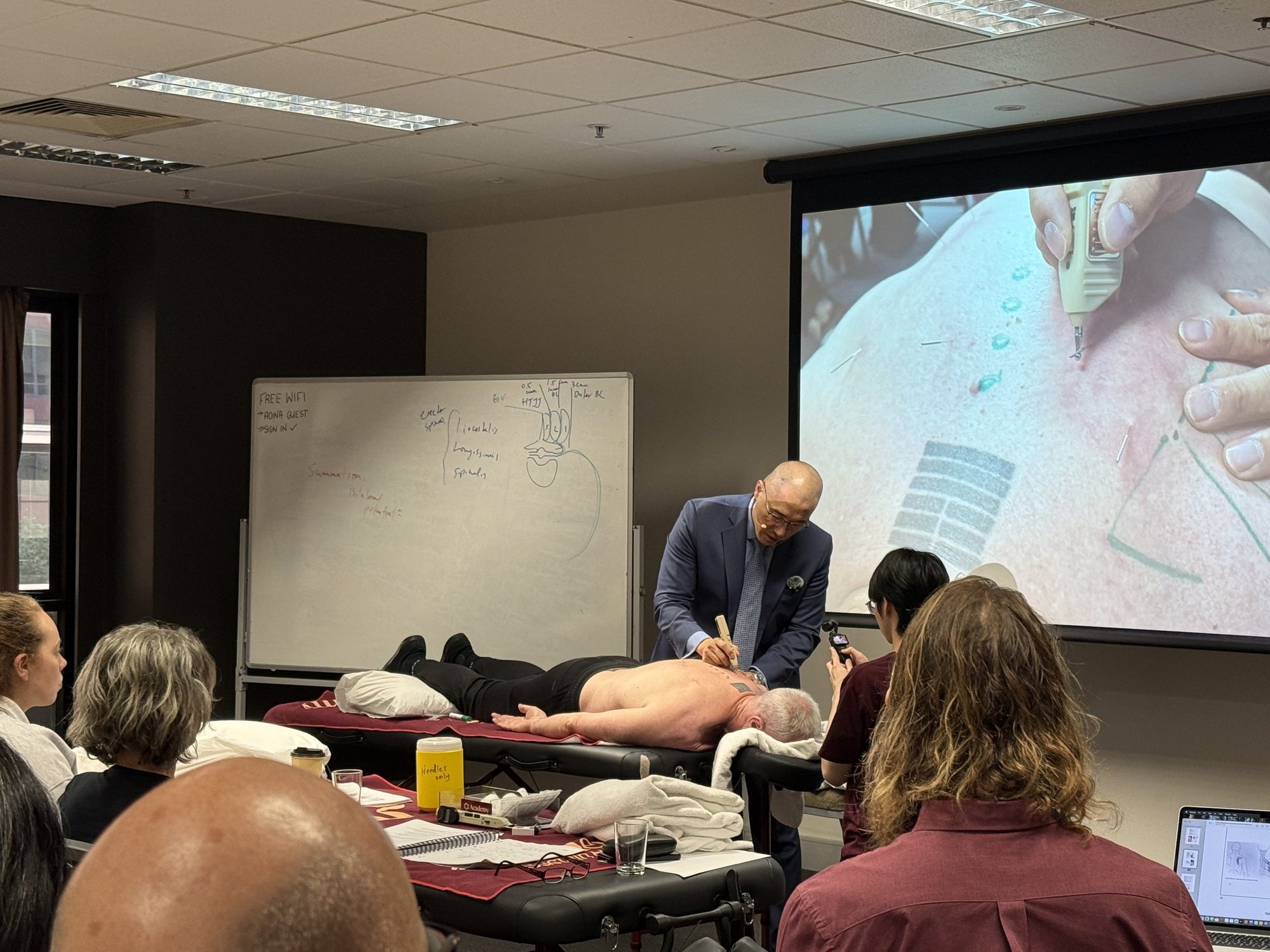
This is supervised practice, not observation. You needle under Dr Chiang's direct correction on placement, angle and depth — so you leave with motor skill, not just conceptual understanding.
Classical Theory Validated, Not Abandoned
The neuroanatomical framework reveals why classical acupuncture points work — it doesn't replace them. You leave with a deeper appreciation of traditional wisdom, plus the precision of modern neuroanatomy layered on top.
The difference isn't talent. It's method.
Meet Dr Poney Chiang
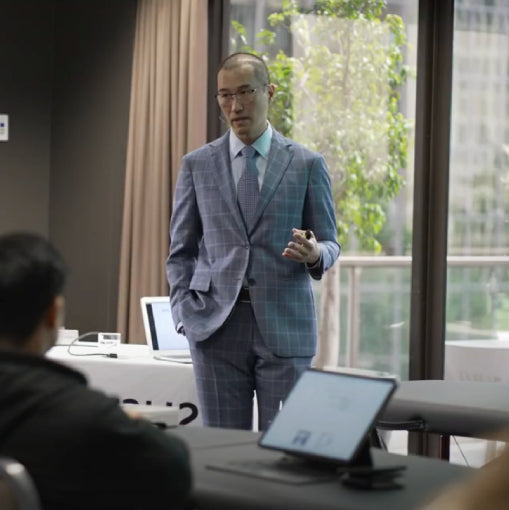
Dr Poney Chiang is one of the world's foremost researchers in neuroanatomical acupuncture. He didn't just study how acupuncture works — he spent decades investigating why it works at the level of peripheral nerve pathways, and built Neuro-Meridian Acupuncture, a complete teaching system, around that research.
His approach doesn't abandon classical TCM — it reveals the neuroanatomical basis of classical points. What looks like intuition in master Acupuncturists is actually precise nerve-branch targeting. Dr Chiang made that targeting teachable, systematic and reproducible.
His four-day intensive combines rigorous neuroscience with live clinical demonstrations and extensive supervised practice — so you leave with skills you can use the very next day.
- PhD in biomedical research, University of Toronto
- Master of Traditional Oriental Medicine, Pacific College of Oriental Medicine, New York
- Founder, Integrative Acupuncture Certificate Program, York University Toronto
- Professor, American Neuro-Acupuncture Institute, Santa Fe, New Mexico
- Leading authority in the peripheral neuro-anatomy of acupoints and neuro-modulation needle techniques
What You Will Be Able to Do After Module 1
By the end of four days you'll have a systematic neuroanatomical framework for upper-extremity, head and neck presentations — with the hands-on skill to apply it from the following week.
Treat upper-extremity conditions systematically
Frozen shoulder, rotator cuff syndrome, carpal tunnel, tennis elbow, trigger finger and De Quervain — with a clear, reproducible pathway for each.
Approach head & neck conditions with precision
Tension headache, migraine, trigeminal neuralgia, facial nerve palsy, TMJ dysfunction and cervicalgia, using targeted neuro-stimulation.
Target nerve branches accurately
Identify and needle peripheral nerve branches at the wrist, forearm, elbow, shoulder, neck and head with correct angle and depth.
Achieve De Qi at a neuroanatomical level
Understand which tissue structures you are stimulating and which responses you are eliciting — rather than relying on sensation alone.
Troubleshoot with the SMART Guideline
Apply a systematic East-and-West framework to adapt in real time when a treatment only partially resolves.
Explain your reasoning in both languages
Articulate your clinical rationale in both classical TCM and modern neuroanatomical terms — to patients and to other providers.
Four Days. Two Body Regions. Dozens of Protocols.
The content is progressive — each day builds directly on the last, so full attendance is required. Days run 9am to 5pm Melbourne time.
Foundations & Upper Extremity I
- Introduction to integrative acupuncture — how classical meridians and modern nerve pathways map to each other
- Neuro-stimulation & De Qi — upper extremity (Parts 1–2): wrist and forearm nerve branches, angle and depth
- The neurological mechanism of acupuncture — the science behind why it works
Upper Extremity II & Live Demonstrations
- Neuro-stimulation & De Qi — upper extremity (Parts 3–5): elbow, shoulder and rotator cuff
- Live protocol demonstrations: trigger finger, De Quervain, lateral epicondylitis, tricep tendinosis, bicipital tendinitis, rotator cuff syndrome
- Supervised hands-on practice with personal feedback from Dr Chiang
SMART Guideline & Neck & Head I
- SMART Guideline: East & West integration — the systematic problem-solving framework
- Neuro-stimulation & De Qi — neck & head (Parts 1–4): cervical nerve roots, occipital and trigeminal pathways
Neck & Head II & Clinical Protocols
- Neuro-stimulation & De Qi — neck & head (Part 5): advanced cervicogenic and cranial nerve techniques
- Live protocol demonstrations: tension headache, migraine, cluster headache, occipital neuropathic headache, allergic rhinitis, TMJ dysfunction, trigeminal neuralgia, facial nerve palsy, cervicalgia
Content is progressive and full attendance is required. Language: English · 26 CPD points total (6.5 per day) · Approved: AACMA & ACUNZ.
Everything You Need to Walk Out a Different Clinician
| ✓ | 4 days of intensive training | With Dr Poney Chiang — full days, 9am to 5pm Melbourne time |
| ✓ | 26 CPD points | 6.5 per day — approved by AACMA & ACUNZ, counts toward annual requirements |
| ✓ | Live protocol demonstrations | 30+ protocols across upper-extremity, head & neck conditions |
| ✓ | Supervised hands-on practice | Personal feedback from Dr Chiang on needle placement, angle and depth |
| ✓ | Comprehensive electronic notes | Detailed reference materials to support clinical application after the seminar |
| ✓ | Certificate of completion | Provided to all full-attendance participants |
The Results Speak for Themselves
Be First in Line for the Next Module 1
The June 2026 Melbourne intake has run. Register your interest and we'll email you first — with priority access and early-bird pricing — the moment the next Module 1 is confirmed.
Your Questions About Module 1
The Difference Isn't Talent. It's Method.
Module 1 transmits decades of Dr Poney Chiang's neuroanatomical research and clinical mastery over four days in Melbourne. Register your interest and we'll make sure you're first to hear when the next edition opens.
Seats are intentionally limited for personal supervision · AACMA & ACUNZ approved