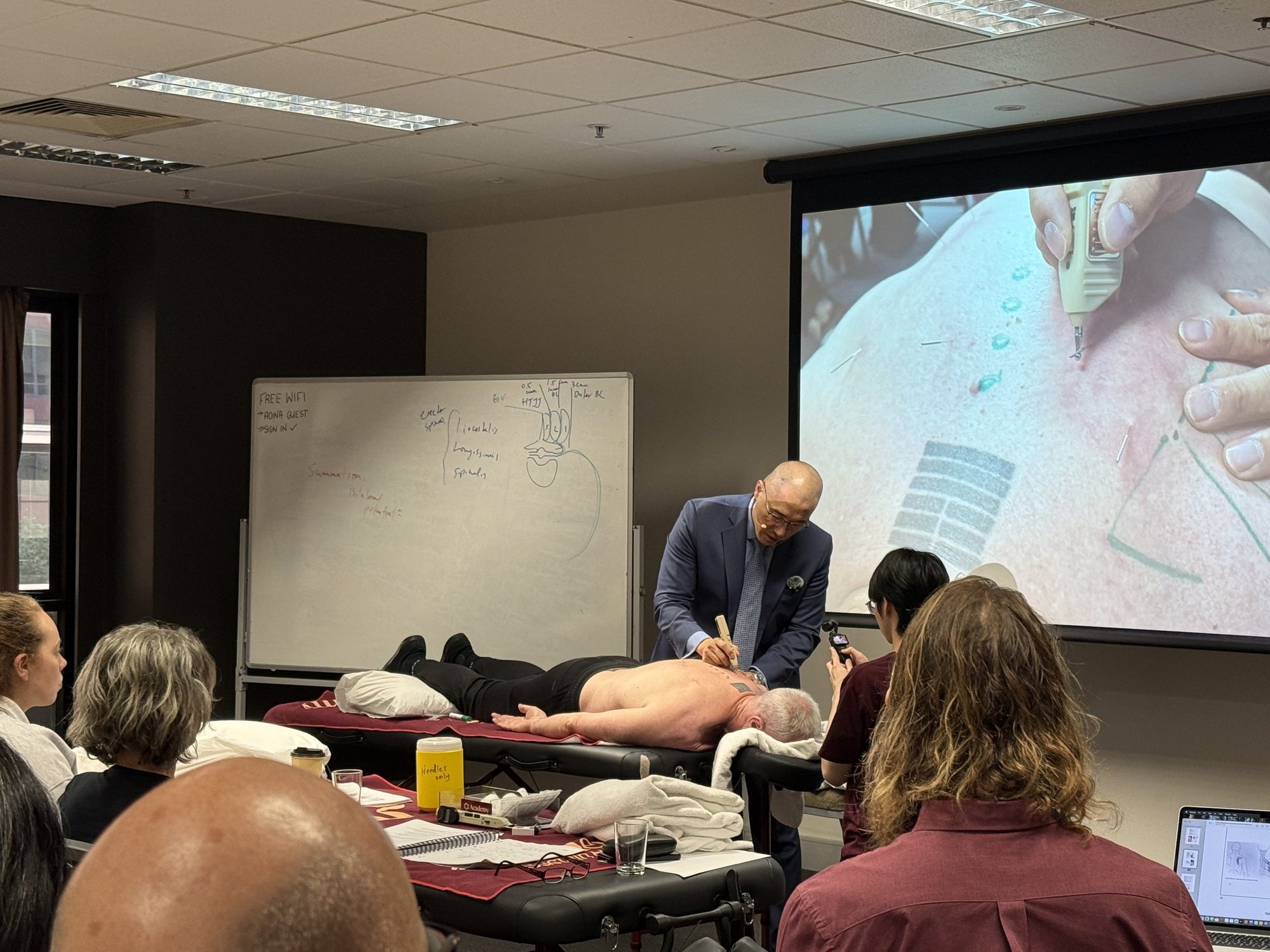
Neuro-Meridian Acupuncture Intensive · Module 3 · Hobart 2027
Master Acupuncture for Complex Neurological Conditions
Four days of post-graduate advanced training in peripheral nerve entrapment and central nervous system dysfunction — with Dr Poney Chiang, PhD, in Hobart.
Central Nervous System Conditions Are the Hardest Cases in Your Clinic — and Generic Protocols Don't Give You a Framework.
You became an Acupuncturist to help patients that Western medicine struggles to help. But when a post-stroke patient presents with minimal improvement, or a Parkinson's case asks what more Acupuncture can offer, the gap between what you know and what you can systematically do feels significant.
Point Lists Without Neuroanatomical Reasoning
Knowing which scalp Acupuncture zones or distal points to use is only part of the picture. Understanding why they connect to specific neural pathways is what allows you to adapt treatment when the expected response doesn't appear.
No Framework for Top-Down vs Bottom-Up Decisions
Some neurological presentations call for a cortical-level approach first. Others need peripheral nerve stimulation before central intervention can be effective. Without this distinction, your treatment sequencing is guesswork.
Peripheral Nerve Entrapments Mistaken for Other Conditions
Scalene entrapment presenting as shoulder pain. Psoas entrapment mimicking hip pathology. The 16 peripheral nerve entrapment syndromes are frequently missed or misattributed — and the treatment protocols differ significantly.
Module 3 is built to close exactly this gap.
Four Integrated Frameworks That Make Neurological Cases Systematic
Dr Poney Chiang's teaching bridges classical Chinese medicine theory with modern neuroanatomy — not as an academic exercise, but as a clinical tool you use the following week.
Neuroanatomical Basis of Acupoints
Every point taught is explained through its neuroanatomical relationships — nerves, vessels, and musculoskeletal structures. Understanding why a point works lets you apply it with precision and adapt when needed.
Peripheral Nerve Entrapment Protocols
Differential diagnosis and treatment protocols for all 16 peripheral nerve entrapment syndromes — from Carpal Tunnel and Cubital Tunnel to Psoas Entrapment and Meralgia Paresthetica.
Top-Down and Bottom-Up Strategies
Dr Poney's dual-methodology framework for CNS conditions. Cortical-level (top-down) approaches for stroke and neurodegenerative presentations; peripheral nerve (bottom-up) strategies for stage-specific recovery.
Research-Backed Clinical Reasoning
Dr Poney is an active MRI researcher. His scalp-to-brain mapping protocols are informed by imaging research into acupoint anatomy — giving you the confidence to explain your treatment rationale in Western anatomical language.
Dr Poney on the Module 3 Approach
In this overview, Dr Poney discusses the central and peripheral nervous system approaches that form the core of Module 3 — including how he applies these frameworks to stroke and Parkinson's disease.
The Researcher Who Mapped the Neuroanatomy of Acupuncture Points
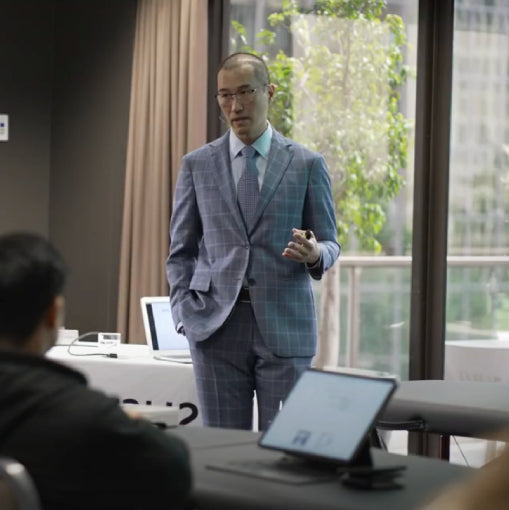
Dr Poney Chiang occupies a rare position in the Acupuncture world: an Acupuncturist with a PhD in biomedical research who has spent his career bridging classical Chinese medicine theory with modern neuroanatomy — not as theory, but as a clinical tool.
His teaching conviction: when you understand the neuroanatomical why behind a point, you apply it with precision — and you can adapt when the clinical picture shifts.
- PhD in biomedical research, Institute of Medical Science, University of Toronto
- Founder, Integrative Acupuncture Certificate Program, Faculty of Health, York University Toronto
- Professor, American Neuro-Acupuncture Institute, Santa Fe, New Mexico
- Leading authority in peripheral neuro-anatomy of acupoints and neuro-modulation needle techniques
- Active researcher: MRI-based study of scalp acupoint anatomy and cortical functional region mapping
What You Will Be Able to Do After Module 3
By the end of four days, you will have a systematic neuroanatomical framework for clinical decision-making across neurological and entrapment presentations.
Diagnose all 16 entrapment syndromes
Assess and differentiate all 16 peripheral nerve entrapment syndromes — from Scalene Entrapment and Radial Tunnel to Tarsal Tunnel and Guyon's Canal — with a specific treatment protocol for each.
Apply top-down & bottom-up methods
Select top-down or bottom-up methodologies for each patient's neurological presentation and stage of recovery — adaptive clinical strategies, not fixed protocols.
Map scalp zones to brain regions
Map scalp Acupuncture zones to specific cortical brain regions using Dr Poney's MRI-informed framework — understanding exactly what you target neurologically with each placement.
Structure care for stroke, MS & Parkinson's
Build clinical approaches for stroke, Multiple Sclerosis and Parkinson's disease using an integrative framework that melds classical TCM theory with modern neurological understanding.
Achieve De Qi at a neuroanatomical level
Understand which tissue structures you are stimulating and which responses you are attempting to elicit — rather than relying on sensation alone as confirmation.
Integrate MRI & CT imaging
Bring Western medical imaging into your Acupuncture diagnosis and treatment planning for neurological conditions — and communicate your clinical reasoning to other providers with confidence.
Sample Agenda — Full Schedule To Be Released
The full day-by-day schedule and daily times will be released closer to the seminar. The sample agenda below shows how the curriculum is expected to flow across the four days. Prerequisite: you must have completed either Module 1 or Module 2 (both are not required).
PNS Entrapment — Upper Extremity I
- Introduction & overview of the 16 peripheral nerve entrapment syndromes
- Upper extremity: Scalene Entrapment, Radial Tunnel, Posterior Interosseous Nerve
- Upper extremity: Wartenberg Syndrome, Pronator Teres, Anterior Interosseous Nerve
PNS Entrapment — Upper Extremity II & Lower Extremity
- Upper extremity: Carpal Tunnel, Cubital Tunnel, Guyon's Canal
- Lower extremity: Psoas Entrapment, Meralgia Paresthetica
- Lower extremity: Piriformis Syndrome, Adductor Tunnel
PNS Entrapment — Lower Extremity & CNS Bridge
- Lower extremity: Peroneal Tunnel, Anterior Tarsal Tunnel, Medial Tarsal Tunnel
- MRI-verified Scalp Acupuncture & treatment strategy
- Staging-dependent assessment and treatment for stroke neuro-rehab
- Acupuncture research for central neurological conditions
CNS Dysfunction — Neurological Conditions
- Yin-Yang Balancing Acupoint-to-Acupoint Penetrative Needling (AAPN) for spastic paralysis
- Auricular Acupuncture for neurological dysfunction
- Assessment and treatment of Multiple Sclerosis, Parkinson's & Motor Neuron Disease
- Summary & review
Sample agenda only — topics are indicative of each suggested day. The full schedule, daily times and CPD breakdown will be released closer to the seminar. Language: English · 26 CPD points total · Approved: AACMA & ACUNZ
Reserve Your Place
Super Early Bird pricing is open now for Acupuncturists ready to commit. Three payment options — choose what suits you.
You're booking: Neuro-Meridian Acupuncture Intensive: Module 3Hobart, Australia · 18–21 March 2027
Late Bird pricing ends 7 February 2027
Late Bird AUD $4,599 · save AUD $100
5% off the Late Bird price · You save AUD $330 off the full price
Pay in full by bank transfer. Your seat is held for 72 hours while your transfer clears.
- ✓ 4 full days · 26 CPD points
- ✓ All seminar materials & certificate of completion
- ✓ Morning tea & afternoon tea each day
Late Bird AUD $4,599 · save AUD $100
2.5% off the Late Bird price · You save AUD $215 off the full price
Pay in full by credit card. Securely processed through Stripe.
- ✓ 4 full days · 26 CPD points
- ✓ All seminar materials & certificate of completion
- ✓ Morning tea & afternoon tea each day
Pay a AUD $500 deposit to hold your seat at today's price. Monthly instalments are available when you book far enough ahead — your options are shown at the next step. Refundable less a 10% admin fee.
Balance due 7 January 2027 — 10 weeks before the seminar, charged automatically to the card you save at checkout.
- ✓ 4 full days · 26 CPD points
- ✓ All seminar materials & certificate of completion
- ✓ Morning tea & afternoon tea each day
Tier dates are set ahead of time and may change without prior notice — the price shown at checkout is the price that applies.
All prices in AUD incl. GST. Spots are held for 72 hours after payment initiation. View Terms, Conditions, Cancellations & Refund Policy
Venue
Vibe Hotel Hobart (4.5★) 36 Argyle St Hobart TAS 7000
Vibe Hotel Hobart (4.5★) 36 Argyle St Hobart TAS 7000
Discounts & rewards — verification required
Student & New Graduate Support Offer — 10% off
In training, or within your first year of clinical practice? We support new Acupuncturists with a registration discount. Verification required.
Apply for the student rate →Refresher Reward — 30% off
Attended this module before? Re-attend at a specially reduced rate to refresh and go deeper. Verification required.
Apply for the refresher rate →Speaker Switch Reward — 30% off
Completed a similar seminar with another provider? Switch to us and claim a special rate. Verification required.
Apply for the switch reward →Your Questions About Module 3
Hobart. 18–21 March 2027. Post-Graduate Neurological Acupuncture Training.
Four days with Dr Poney Chiang — and a systematic, research-backed framework for every complex neurological case in your clinic. Super Early Bird seats are limited and allocated first-come, first-served.
Register NowSeats first come, first served.